.svg)
Ergonomic Kitchen Design
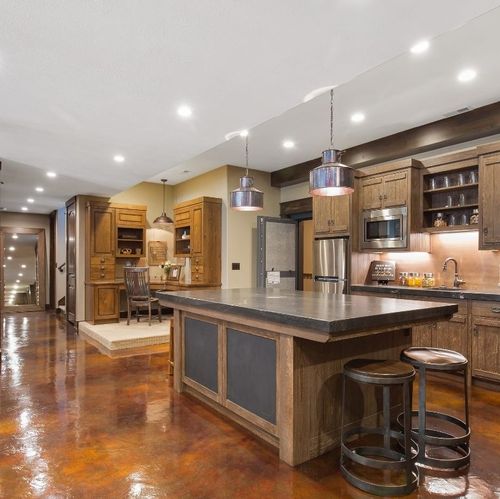
An ergonomic kitchen is one designed around the needs of the people who will use it most, with items positioned and spaced to minimize reaching, bending, and unnecessary movement. Ergonomics in kitchen design often starts with the 3 most used items in a kitchen: the refrigerator, oven, and sink, and their relationship to each other. This “work triangle” concept has been around since the 1940s, and is still one of the key starting points for kitchen design today. An ergonomic kitchen will have these 3 items positioned so that the distance between each is minimized, allowing for efficient movement between the 3 most used items in your kitchen.
Ergonomics also considers the height at which things are positioned in a kitchen. Counter height, for instance, is typically set at 36”, which is ideal for an adult of average height. But if you're taller or shorter, you may want to consider adjusting the counter height to reduce strain on your back and arms while working in the kitchen. Similarly, the depth of the counter (front to back) can affect how comfortable it is to work in the kitchen. If you have a lot of items stored on the counter, you may want a deeper counter to keep things within easy reach.
Storage is another important consideration in ergonomic kitchen design. The goal is to keep frequently used items within easy reach, and items used less often in less accessible locations. This means thinking about what goes where: pots and pans close to the stove, dishes close to the dishwasher, food close to where it will be prepped. It also means thinking about how things are stored: in drawers or on shelves? In cabinets or on open shelves? The goal is to make it as easy as possible to find and retrieve items when you need them.
Finally, ergonomic kitchen design also considers the flow of the kitchen. The goal is to minimize the distance you have to travel to get from one area to the kitchen to another. This means thinking about where the sink, stove, and refrigerator are located relative to each other, and making sure there is enough space to move between them easily. It also means thinking about where the garbage and recycling bins are located, and making sure they are accessible from all parts of the kitchen.
An ergonomic kitchen will also consider the needs of all users. If there are small children in the household, you'll want to make sure that items that could be hazardous to them are stored out of reach. If there are elderly or disabled users, you'll want to make sure that the kitchen is accessible to them, with items stored at heights that are easy for them to reach.
Ergonomic kitchen design can make the kitchen a more efficient, comfortable, and safe place to work. If you'd like more information about what type of features we can create to help you create an ergonomic kitchen in Ottawa give us a call today. If the kitchen is the most important room in your home, this is one investment where the ROI is going to be astronomical.
Ready to renovate? Explore our kitchen renovation services in Ottawa to see how OGC can transform your space.
.jpeg)